PlacesProvince
Punjab
Punjab has 127,688,922 people and covers 205,345 sq km.
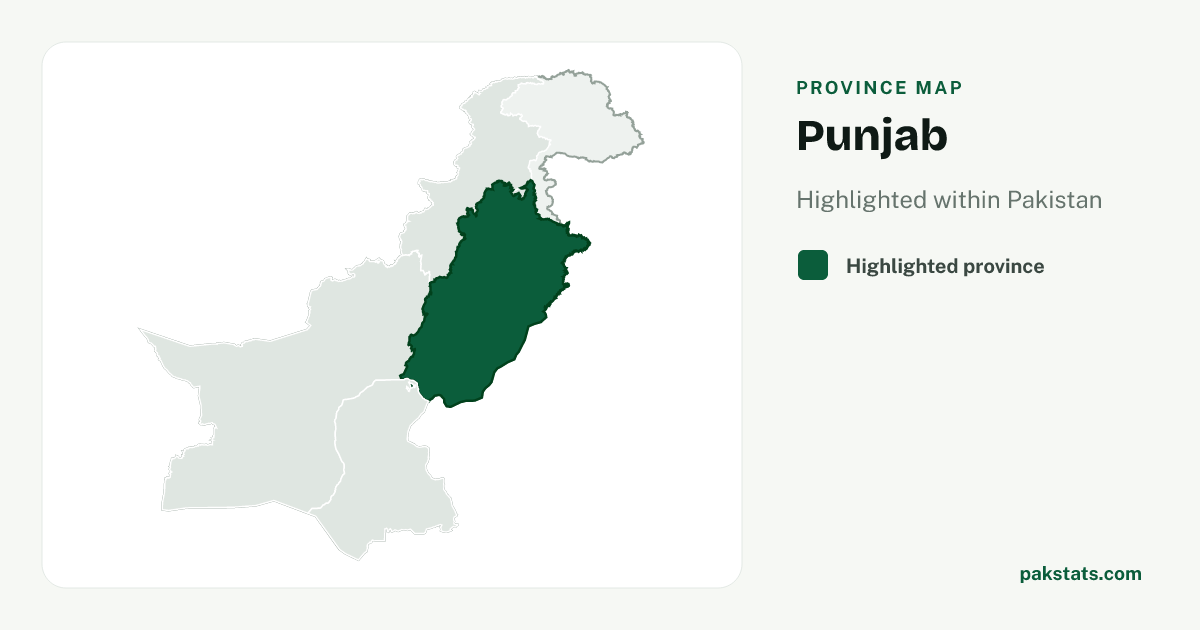
Province map
Map of Punjab
127,688,922
People counted in the 2023 census
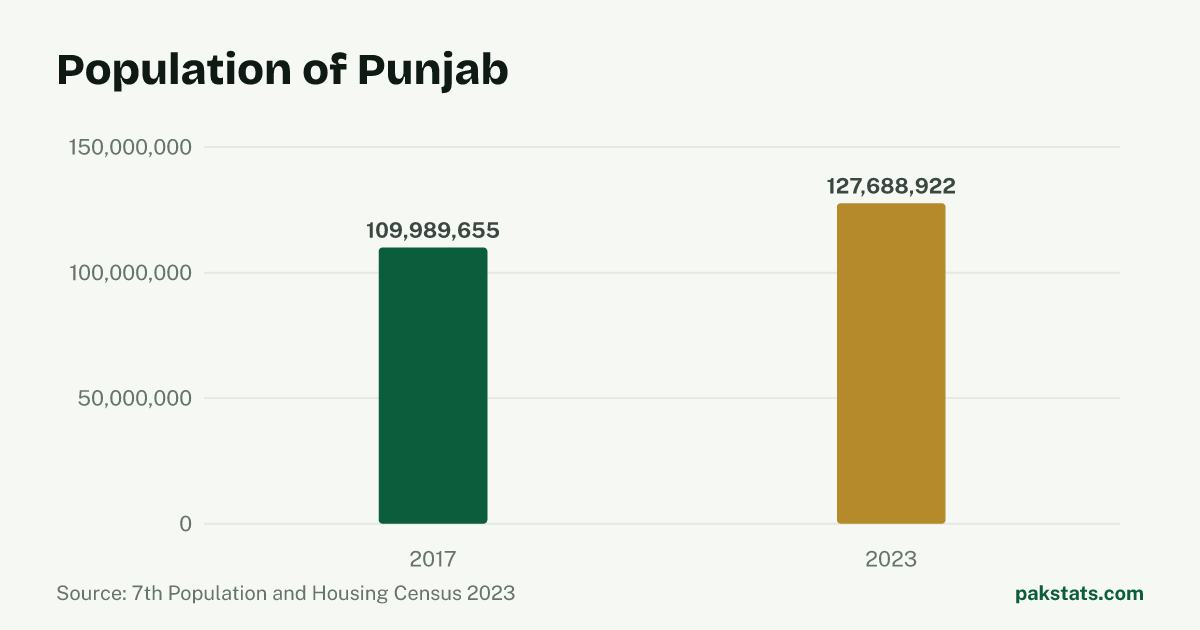
Change since 2017
| Census | People |
|---|---|
| 2023 | 127,688,922 |
| 2017 | 109,989,655 |
Key numbers
- 205,345 sq kmArea
- 621.8People per sq km
- 40.7%Share living in towns and cities
- 6.4People per household
- 105.18Men per 100 women
- 2.53%Population growth a year
Who lives here
| Group | People | Share |
|---|---|---|
| Men | 65,448,376 | 51.3% |
| Women | 62,226,589 | 48.7% |
| Transgender people | 13,957 | 0.0% |
| People in villages | 75,712,955 | 59.3% |
| People in towns and cities | 51,975,967 | 40.7% |
Literacy and school attendance
PBS defines this literacy rate for people aged 10 and older. Rural and urban values are shown only where the census reports them.
| Group | Literacy rate |
|---|---|
| Overall | 66.2% |
| Men | 72.0% |
| Women | 60.2% |
| Rural | 58.4% |
| Urban | 77.3% |
9,600,164 children aged 5–16 were recorded as out of school.
Inside Punjab
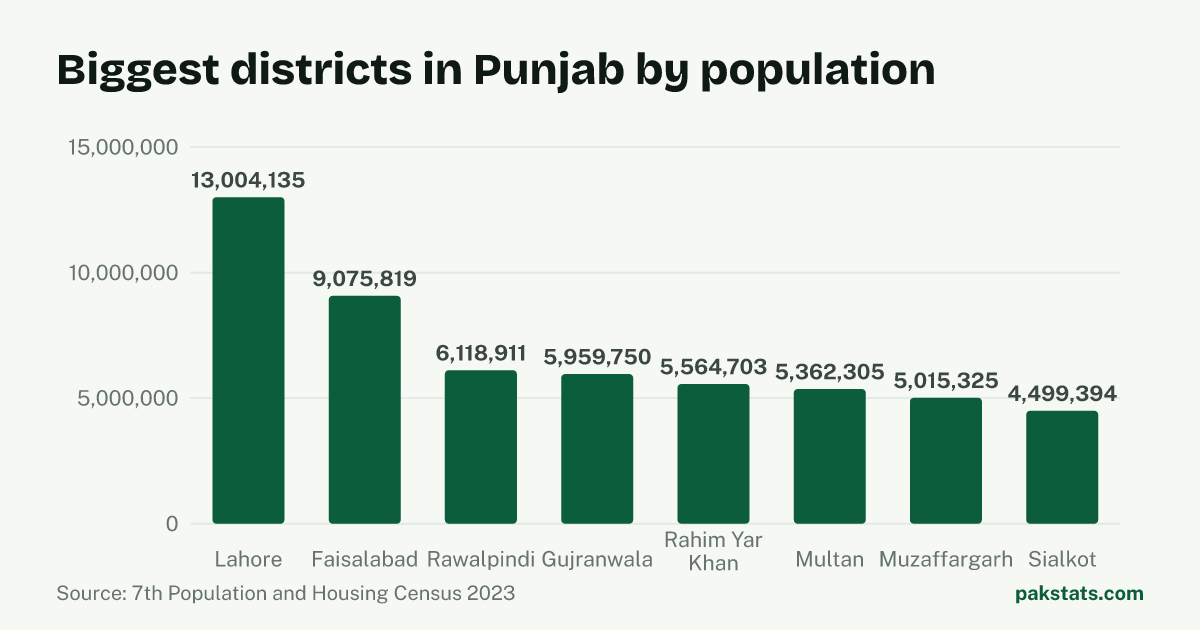
| District | People | Area (sq km) | Share |
|---|---|---|---|
| Lahore | 13,004,135 | 1,772 sq km | 10.2% |
| Faisalabad | 9,075,819 | 5,857 sq km | 7.1% |
| Rawalpindi | 6,118,911 | 5,285 sq km | 4.8% |
| Gujranwala | 5,959,750 | 3,622 sq km | 4.7% |
| Rahim Yar Khan | 5,564,703 | 11,880 sq km | 4.4% |
| Multan | 5,362,305 | 3,720 sq km | 4.2% |
| Muzaffargarh | 5,015,325 | 8,249 sq km | 3.9% |
| Sialkot | 4,499,394 | 3,016 sq km | 3.5% |
| Sargodha | 4,334,448 | 5,856 sq km | 3.4% |
| Bahawalpur | 4,284,964 | 24,830 sq km | 3.4% |
| Kasur | 4,084,286 | 3,995 sq km | 3.2% |
| Sheikhupura | 4,049,418 | 3,744 sq km | 3.2% |
| Bahawalnagar | 3,550,342 | 8,878 sq km | 2.8% |
| Okara | 3,515,490 | 4,377 sq km | 2.8% |
| Vehari | 3,430,421 | 4,364 sq km | 2.7% |
| Dera Ghazi Khan | 3,393,705 | 11,922 sq km | 2.7% |
| Khanewal | 3,364,077 | 4,349 sq km | 2.6% |
| Gujrat | 3,219,375 | 3,192 sq km | 2.5% |
| Jhang | 3,065,639 | 6,166 sq km | 2.4% |
| Sahiwal | 2,881,811 | 3,201 sq km | 2.3% |
| Toba Tek Singh | 2,524,044 | 3,252 sq km | 2.0% |
| Rajanpur | 2,381,049 | 12,318 sq km | 1.9% |
| Attock | 2,170,423 | 6,857 sq km | 1.7% |
| Pakpattan | 2,136,170 | 2,724 sq km | 1.7% |
| Layyah | 2,102,386 | 6,289 sq km | 1.6% |
| Bhakkar | 1,957,470 | 8,153 sq km | 1.5% |
| Narowal | 1,950,954 | 2,337 sq km | 1.5% |
| Lodhran | 1,928,299 | 2,778 sq km | 1.5% |
| Mandi Bahauddin | 1,829,486 | 2,673 sq km | 1.4% |
| Mianwali | 1,798,268 | 5,840 sq km | 1.4% |
| Chakwal | 1,734,854 | 6,525 sq km | 1.4% |
| Nankana Sahib | 1,634,871 | 2,216 sq km | 1.3% |
| Chiniot | 1,563,024 | 2,643 sq km | 1.2% |
| Khushab | 1,501,089 | 6,511 sq km | 1.2% |
| Jhelum | 1,382,308 | 3,587 sq km | 1.1% |
| Hafizabad | 1,319,909 | 2,367 sq km | 1.0% |
Common questions about Punjab
- What is the population of Punjab?
- Punjab had 127,688,922 people in the 2023 census. The 2017 census counted 109,989,655, so there are 17,699,267 more people now.
- How fast is Punjab growing?
- The population of Punjab grew 2.53% a year between the 2017 and 2023 censuses. That is slower than Pakistan as a whole, which grew 2.55% a year.
- How big is Punjab?
- Punjab covers 205,345 square kilometres. That works out at 621.8 people per square kilometre. A household here holds 6.4 people on average.
- How many people in Punjab live in towns and cities?
- 51,975,967 people in Punjab live in towns and cities and 75,712,955 live in villages. That makes it 40.7% urban.
- How many men and women live in Punjab?
- The census counted 65,448,376 men and 62,226,589 women in Punjab. It also counted 13,957 transgender people. That is 105.18 men for every 100 women.
- What is the literacy rate in Punjab?
- The 2023 census literacy rate for people aged 10 and older in Punjab was 66.2%. It was 72.0% for men and 60.2% for women, a gap of 11.8 percentage points.